March 23, 2026
Rates pause, housing improves modestly, and policy momentum builds
Brackets busted.
Every March, millions of people fill out March Madness brackets hoping for a perfect bracket. For most, those dreams go up in flames after the first games tip off.
If your bracket is already busted, you’re not alone. The odds of filling out a perfect bracket are 1 in 9.2 quintillion. For perspective, you’d have a better chance of correctly guessing a single grain of sand that was chosen from all the sand on Earth (1 in 7.5 quintillion).
This week, the Fed leaves rates, builder confidence and home sales rise, and affordability legislation moves forward.
Fuel up! 🚀


Bizz Buzz
Fed holds rates steady
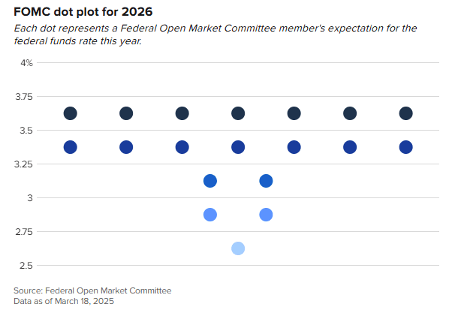
The Federal Reserve left the federal funds rate unchanged on Wednesday, a move that was widely expected heading into the meeting. This is the second straight meeting that the committee has held rates at 3.50% – 3.75%.
At the start of the year, markets were anticipating multiple rate cuts in 2026. The outlook has since shifted, with expectations now pointing to just one potential cut in the second half of the year as inflation concerns remain elevated.

Builder confidence slightly higher in March
The National Association of Home Builders (NAHB)/Wells Fargo Housing Market Index (HMI), which tracks the pulse of the single-family housing market, rose one point in March to 38, still in the pessimistic territory.
The three indices in March:
- Current sales conditions: 42 (+1 point).
- Sales expectations in the next 6 months: 49 (+2 points).
- Traffic of prospective buyers: 25 (+3 points).
NAHB Chief Economist Robert Dietz noted that while the 30-year fixed mortgage rate averaged 6.05% in February, its lowest level since August 2022, down payment constraints and broader uncertainty, including geopolitical tensions and rising oil prices, are going to be headwinds going forward.
Pending home sales increase in February
Pending home sales rose 1.8% in February from the previous month, signaling a modest increase in housing activity. However, compared to last year, sales are down 0.8%, which shows the overall market is still subdued.
The month-over-month increase can be attributed to better affordability, with the Midwest, South, and West all seeing gains. In contrast, activity declined in the Northeast, where higher prices and limited supply continue to weigh on demand.
Caffeinated Trends
Two housing bills converge as negotiations begin
Recently, we touched on multiple pieces of legislation that aim to limit the impact that large corporations have held in the housing market for years. Last week, the Senate passed the bipartisan 21st Century ROAD to Housing Act by a margin of 89 to 10. This comes in response to the Housing for the 21st Century Act, which was passed by the House in February by a margin of 390 to 9. While some stark differences exist between the two proposals, lawmakers on both sides agree that housing is too expensive and remains a problem that must be addressed.
Moving forward, these two bills will be adapted into one version negotiated between the Senate and the House. Once the finalized version is agreed upon, it must pass through both the House and the Senate prior to receiving President Trump’s approval. Negotiations are expected to occur over the next few months, with the final legislation not likely to pass until the second half of the year. President Trump’s sign-off remains a potential obstacle for lawmakers to overcome. He has been consistent in his messaging to get the SAVE America Act approved, which would introduce legislation aimed at reforming voting regulations. He is quoted saying, “I’m not going to sign anything until this is approved,” which could have a direct impact on any further legislation until it’s approved.
The 21st Century ROAD to Housing Act seeks to increase access to homeownership by addressing multiple issues within the housing market, such as:
- Reforming regulations around homebuilding to streamline the process and increase supply within the U.S.
- Creating programs to offer grants for local governments to “assist planning and implementation activities associated with affordable housing.”
- Reducing costs for both homeowners and buyers by modifying requirements to enter programs.
One of the largest sticking points continues to center around any attempt to limit institutional investors within the housing market. As negotiations progress over the next few months, we will continue to monitor any progressions and changes between the two sides.
This week’s puzzle gets 4 Rockets out of 5.
4 Rockets
This article is for informational purposes only, and is not a substitute for professional advice from a medical provider, licensed attorney, financial advisor, or tax professional. Consumers should independently verify any service mentioned will meet their needs.