April 6, 2026
Fed holds steady, housing shifts, and the rise of prediction markets
Recently, a once in a century crater was discovered on the moon! During a routine search, NASA’s Lunar Reconnaissance Orbiter uncovered a new crater as wide as two American football fields. According to predictions, a crater that big should form only once in 139 years.
Speaking of events, in this weeks edition we’ll be diving into prediction markets, announcements from the Fed Chair, and further updates around the housing market.
Fuel up! 🚀

-700x700.webp&w=1290&q=100)
Bizz Buzz
Fed Chair Powell speaks on inflation
This week, Federal Reserve Chair Jerome Powell sat down for a talk at Harvard University. He took the opportunity to address questions and concerns about interest rate movement in 2026. Despite uncertainly around the Iran War and rising energy prices, Powell believes that the current rate target, between 3.5% – 3.75%, is a good place for the Fed to sit as it observes events currently playing out.
As a result, traders within financial markets are no longer accounting for a potential rate hike at some point this year. Additional market-based measures such as breakeven rates in Treasury yields also indicate few fears of an inflation boom. Powell also noted that Fed rate moves historically have a lagged impact on the economy, so any hikes at this time wouldn’t offset the inflation experienced from the Iran War.
February housing inventory update
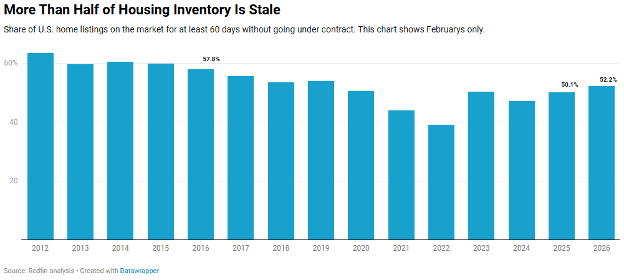
According to Redfin.com, more than half of February’s home listings were on the market for at least 60 days without going under contract. This is up 50.1% year-over-year, and the highest share seen since 2019. Since there is a seasonal factor to this data, the comparison below looks at past February’s dating back to 2012.

Japan becoming larger factor in U.S. housing market
While Japan has always invested in the U.S. housing market, a flurry of recent deals has pushed Japanese firms to controlling about 6% of American Home construction. They have finalized 23 deals for U.S. single-family buyers since 2020, over double the pace of the prior seven years. Despite the current uncertainly within the market, Japanese firms view the U.S. housing market as a more worthy investment than their own situation at home. With borrowing costs lower in Japan, these firms can afford bigger investments and often win when competing for deals. That being said, this isn’t leading to wholesale changes at this point. Japanese buyers often tend to leave management teams in pace while providing additional capital for the company to utilize.
Caffeinated Trends
What happens when you can bet on everything?
Prediction markets are booming, allowing anyone to place bets on events from sports outcomes to global conflicts. In the past year alone, platforms like Kalshi and Polymarket handled more than $40 billion in “event contracts,” giving everyday investors the opportunity to take financial positions on real-world outcomes. Yet as these markets grow, questions emerge around whether participants can trust that the system is fair.
Unlike traditional gambling platforms, prediction markets are regulated by the federal Commodities Futures Trading Commission (CFTC) rather than state gambling authorities. This framework has allowed rapid expansion, but has also created a patchwork of oversight. Lawmakers and regulators are taking notice, with bipartisan legislation being introduced to clarify regulatory authority and the CFTC reviewing new guidance to prevent manipulation, particularly in sports and other high-profile markets.
Trust in these markets is far from abstract. Insider trading and manipulation are real risks, as illustrated by former NBA player Jontay Porter, who coordinated underperformance in games to profit from bets. Platforms depend on confidence that no participant can game the system. Without that confidence, both regulators and users may question their reliability and legitimacy.
In response, both Kalshi and Polymarket have implemented preemptive rules and monitoring systems to curb insider trading. Measures include banning athletes, coaches, and political candidates from trading on events they influence, as well as partnering with compliance firms to detect any suspicious activity. These efforts signal a turn from experimental platforms toward more sophisticated operations designed to preserve integrity and maintain user trust.
As prediction markets scale, they are reshaping how people engage with information and events. Easy mobile access, gamification, and social pressures can blur the line between observation and speculation, while ethical and psychological questions multiply. Whether these platforms evolve into trusted forecasting tools or face tighter constraints may depend less on demand and more on whether they can convince both regulators and users that the system is indeed fair. While the markets are growing quickly, this question of trust remains central to whether they will thrive or stumble along the way.
This week’s puzzle gets 2 Rockets out of 5.
2 Rockets
This article is for informational purposes only, and is not a substitute for professional advice from a medical provider, licensed attorney, financial advisor, or tax professional. Consumers should independently verify any service mentioned will meet their needs.