October 27, 2025
Government shutdown continues: Key insights brokers need for their clients
Stellantis, the parent company of Chrysler, Jeep, and other auto brands, announced plans to invest $13 billion in U.S. manufacturing operations over the next 4 years.
This investment will create over 5,000 jobs for its domestic workforce while increasing domestic production by 50%. With recent news about a weakening labor market, this signals continued confidence in domestic economic growth and job creation.
This week, we cover trends around buyers, recent builder incentive updates, and the Amazon Web Services (AWS) outage, and take a deep dive into the government shutdown.
Fuel up! 🚀


Bizz Buzz
Buyers: Playing the waiting game
Despite mortgage rates reaching their lowest point in the past year, buyers remain hesitant due to concerns about job security and high home prices.
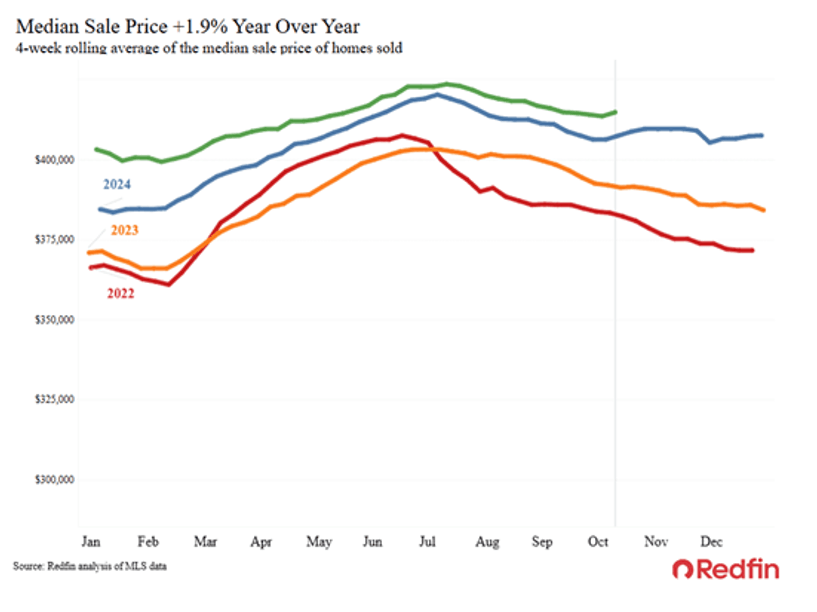
While new listings of U.S. homes for sale have risen 4.1% year over year in October, pending home sales have done the opposite by falling 1.2%. The reduction in rates has not been reflected in housing prices, with the median home-sale price still up 1.9% year over year. Buyers may continue to wait for rates to drop below 6% before taking the plunge.
Builder price-cutting and incentives
In response to affordability issues among potential buyers, builders are rolling back prices to bring more homes to the closing table.
According to the latest National Association of Home Builders/Wells Fargo Housing Market Index, 38% of builders reported cutting prices in October alone. Sixty-five percent of builders are also implementing additional incentive programs such as mortgage rate buydowns or upgrade packages.
These reductions are helping buyers who currently feel priced out of a competitive market. Existing-home prices continue to increase monthly, with the median existing-home price in August at $422,600 compared to a median new-home price of $413,500. Historically, new homes have always sold for much more than existing homes. This provides a unique opportunity for builders to capitalize on the current market conditions and entice more buyers to pull the trigger on a home.
Amazon outage sparks issues
On October 20, AWS experienced extreme outages that affected nearly a third of the internet. While Amazon made an announcement that things were being fixed in the morning, the outage persisted throughout the day, affecting thousands of businesses globally. This impacted all types of industries, from financial services and social media to streaming services and even local restaurants who experienced ineffective card readers.
The outage also had a significant impact on Amazon itself. Early estimates signal that the outage cost nearly $75 million per hour, with Amazon accounting for $72 million of it per hour. Those who have been critical of relying on only a few major internet providers used this outage as further proof that we have become over-reliant in this space.
Caffeinated Trends
Government shutdown continues
At midnight on October 1, the federal government entered a shutdown, and it has failed to reopen since. As of this writing, this would be the second longest shutdown in history and is quickly approaching the longest (34 days beginning in December 2018). The current shutdown shows limited signs of ending as Congress remains in a stalemate over a new spending bill and the impacts are mounting.
Around 750,000 federal workers have been placed on furlough because of the shutdown, and it’s starting to impact their finances as partial and missed paychecks begin to stack up. If the shutdown lasts through the end of October, 1.8 million paychecks will be withheld from employees.
The impacts of a government shutdown can be felt across the economy, and the mortgage industry is no different. Delays are the most common by-product of a government shutdown with many agencies such as the Federal Housing Administration (FHA) and Department of Veterans Affairs (VA) not operating at full capacity.
Impacts can include:
· Obtaining tax return transcripts from the Internal Revenue Service (IRS)
· Employment verifications from government agencies
· Flood insurance approvals from the Federal Emergency Management Agency (FEMA)
Two government agencies, Fannie Mae and Freddie Mac, don’t rely on federal funding and are able to continue operating normally.
Impact on the Federal Reserve
Typically, during a government shutdown, mortgage rates move favorably. This is because uncertainty increases during a shutdown, and investors seek out “safe” investments, and demand for government bonds increases, which helps to pull mortgage rates down slightly.
The Fed, which meets even during a government shutdown, faces increased challenges with many key economic reports being delayed or halted altogether. The Bureau of Labor Statistics (BLS) provides key inflation (CPI and PPI) and employment data (unemployment rate) and is also affected by the shutdown. Due to the importance of the CPI report, the BLS has called back some employees to get out the inflation report for September after a week and a half delay.
The next Federal Reserve meeting is scheduled for October 28 and 29 – the second-to-last meeting of the year. Despite the lack of economic data and the increased uncertainty, markets are overwhelmingly expecting a rate cut of 25 bps.
Rocket Pro on the Road
Stay prepared by engaging with industry leaders and discovering what’s next. We’ll be at these top events, let’s connect!
· November 6 – 8: National Guard Association of Michigan State Conference, Detroit, MI
· November 11: California Mortgage Expo, Pasadena, CA (Free registration with code RocketFree)
Two solvers finished last week’s puzzle in under a minute, with our winner coming in at 40 seconds. We’re dialing the next puzzle back a little bit; this week’s puzzle gets 1 out of 5 Rockets.
1 Rocket